If you’re shopping for dental insurance in Colorado, my first suggestion is to ask your dentist whether they offer an in-house membership plan.
I help people choose insurance for a living, but I don’t think buying a dental policy is automatically the best answer. Depending on your dentist, the care you need, and the available benefits, a membership plan, or simply paying directly, can make more sense.
Dental insurance can still be useful. The important part is understanding what you’re buying before you start paying premiums.
Want to compare insurance options? Use our instant Colorado dental quotes tool to explore Marketplace dental plans, compare premiums and benefits, and view plans side by side.
Start with your dentist’s membership plan
Some dental offices offer their own membership programs. You pay a monthly or annual fee, which may include routine exams, cleanings, and certain X-rays, plus discounts on additional treatment.
These programs aren’t dental insurance. Their value depends on the particular office’s prices and membership terms.
If you already have a dentist you like, this is often where I recommend starting. Ask:
- What services are included, and how often?
- What does the membership cost for a full year?
- What discounts apply to fillings, crowns, and other treatment?
- Does it include any care from specialists, or only services at that office?
- Are there exclusions, cancellation restrictions, or renewal requirements?
A membership can be a good fit if you expect to keep using that practice. It may be less useful if much of your treatment will happen elsewhere.
How dental insurance differs from medical insurance
Many people expect dental insurance to protect them from large bills in the same way medical insurance does. Adult dental coverage often works differently. Many dental policies have an annual benefit maximum: a limit on how much the insurance company will pay toward covered care during the year.
That’s different from a medical plan’s out-of-pocket maximum, which limits what you pay for covered, in-network care. For example, a dental policy with a $1,500 annual benefit maximum generally limits the insurer’s payments to $1,500, subject to the policy’s terms. It doesn’t mean your own dental expenses stop at $1,500. You may still owe deductibles, your share of covered services, charges for excluded treatment, and costs after the benefit maximum is reached.
Adult dental plans with no annual benefit maximum
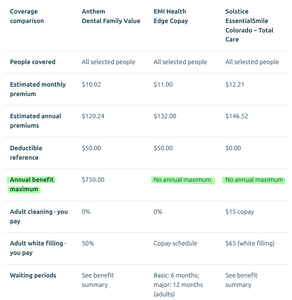
Some dental plans available through Connect for Health Colorado offer adult coverage with no annual benefit maximum. That means the insurer doesn’t stop paying for covered services simply because its payments reach a yearly dollar cap. This is a significant advantage over a dental policy that limits annual benefits to $750, $1,500 or $2,000, particularly if you need substantial covered treatment.
No annual benefit maximum doesn’t mean every procedure is covered or that you pay nothing. Check the plan’s deductible, coinsurance, covered services, exclusions, and dentist network.When comparing dental insurance, I recommend giving these plans a close look alongside your dentist’s in-house membership option.
Get instant Colorado dental quotes and compare plans.
What to compare before buying dental insurance
Your dentist’s exact network participation
“We accept that insurance” isn’t always the same as being an in-network provider for the specific plan.
Confirm the network with both the dental office and the insurer. If you use an out-of-network dentist, ask how reimbursement is calculated and whether you could owe charges above the amount the plan recognizes.
Waiting periods
Some plans cover preventive care immediately but require you to wait before receiving benefits for other services.
If you already need treatment, check whether that particular procedure would be covered on the date you expect to receive it. Buying a policy today doesn’t necessarily help with a crown next week.
Coverage for the work you actually need
Don’t stop at a statement such as “major services covered.” Check the details for your procedure.
Crowns, implants, dentures, orthodontics, and replacement of previously missing teeth can have different limits or exclusions. Plans may also restrict how often they cover replacement work.
The full annual cost
Add up the premiums for a year, then consider the deductible and your share of treatment costs.
Compare that total with your dentist’s membership option and a written price for paying directly. Insurance may provide useful savings, but the monthly premium alone won’t tell you whether it’s a good deal.
Insurance, membership, or paying directly?
| Option | When it’s worth considering | What to check |
|---|---|---|
| Dental insurance | The network and benefits fit your dentist and expected care | Premiums, waiting periods, benefit maximums, exclusions, and your share of costs |
| Dentist’s membership plan | You like your dentist and expect to continue using that office | Included services, treatment discounts, specialist care, and membership terms |
| Paying directly | You want to compare the actual treatment price without another recurring payment | Written estimates, payment discounts, and the cost of unexpected treatment |
| Dental discount plan | Participating dentists offer useful discounts for the services you need | Exact provider participation, discounted fees, and membership costs; it isn’t insurance |
Compare the costs: dental insurance vs. a dentist’s membership plan
Already facing a large dental bill?
Start with a written treatment plan showing the procedures and prices. Then compare what you would actually pay under each option.
Ask whether a proposed insurance policy covers the treatment, whether a waiting period applies, and how much benefit would remain after any other care.
For substantial treatment, a pretreatment estimate from the insurer can help clarify expected benefits, although it isn’t a guarantee of payment.
The useful question is “What will this option save me on the care I need?” A list of impressive-looking benefits doesn’t answer that by itself.
What about children’s dental coverage?
Children’s dental coverage has different rules from typical adult dental coverage.
Before buying another policy, check whether your child already has dental benefits through a medical plan, a separate dental plan, Health First Colorado, or Child Health Plan Plus. Don’t assume the adult benefit limits described above apply to your child’s coverage.
Help comparing your options
If you’re considering dental coverage, contact us with your dentist’s name, who needs coverage, and any treatment you already know about.
We can help you sort through the options. If your dentist’s own membership program looks like the better fit, I’ll tell you that.